

Technical Books by C.T. Jones
The Essential Guide to Mastering MadCap Flare
The Essential Guide to Mastering MadCap Flare is primarily intended for those beginning but want a quick start to eventually mastering Flare. The book covers the various tasks you’ll encounter in developing and implementing Flare projects. In addition, you’ll get an introduction to the primary UI components — including Editors, Windows, and Menus; as well as a guide to using the many tools and features designed to enhance the outputs and to make your job easier along the way.
Much consideration went into the content and design of this book. Given the seemingly endless ways to do each job in Flare and the lack of a fixed sequence, a primary goal was to include everyday tasks a user would eventually need to perform. Then, briefly present each task by describing its basic concept and essential elements, and providing appropriate application tips. The idea was to gather the topics necessary to help you get right to work and become productive with Flare.
You can read the book from cover to cover if you like, but that is unnecessary. If you are new to Flare, the tutorial at the start of each chapter is a great place to begin. As your project calls for a specific task, turn to the appropriate topic for a quick introduction, followed by a step-by-step procedure. Using the Table of Contents, you can quickly find a particular task, and the Appendices offer additional practical information. With the Glossary and Index, you can soon become familiar with Flare-specific and related terminology.
Details
470 pages
Chapters: 12
Appendix: Yes
Glossary: Yes
Index: Yes
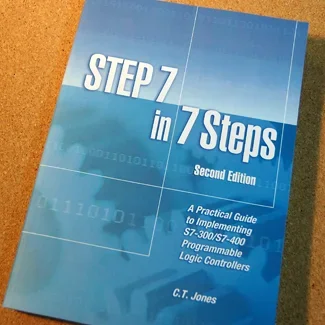
STEP 7 In 7 Steps
A Practical Guide To Implementing
S7-300/S7-400 Programmable Logic Controllers, 2nd Edition
This unique new book has done it all! The book is uniquely organized to include seven practical steps associated with getting the job done efficiently and painlessly. A task-oriented guide to configuring, programming, deploying, troubleshooting, and maintaining S7-300/S7-400 PLCs and Simatic Networks. Each of the seven task areas is introduced with a brief tutorial, followed by several examples of actual tasks.
Each task is presented in an identical two-page spread layout. On the left-hand page, the task is described under the headings Basic Concept, Essential Elements, and Application Tips. On the right-hand page, the task is presented in a step-by-step table format. With over 175 example tasks, your tasks are surely already done! A great sidekick for every STEP 7 user!
Chapters
1: Getting Started
2: Working with Projects and Libraries
3: Working with Hardware Configurations
4: Working with Programs and Data
5: Managing Online Interactions with the CPU
6: Working with Monitoring and Diagnostic Tools
7: Working with Simatic Network Configurations
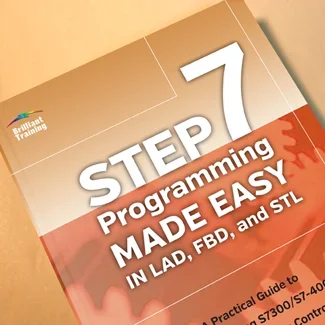
STEP 7 Programming Made Easy in LAD, FBD, and STL
A Practical Guide To Programming S7-300/S7-400 Programmable Logic Controllers
Finally – programming STEP 7 in LAD, FBD, and STL is made crystal clear! STEP 7 Programming Made Easy is designed to introduce and thoroughly cover every important aspect of developing STEP 7 programs in LAD, FBD, and STL. You’ll learn to correctly apply and develop your STEP 7 program, using S7 resources from addressing S7 memory areas and I/O modules, to using Functions, Function Blocks, Organization Blocks, and System Blocks.
With more than 500 illustrations and examples, understanding STEP 7 is certainly made easy! Now, with both STEP 7 Programming Made Easy and STEP 7 in 7 Steps, a Siemens S7 developer has all the needed tools to get the job done!
About This Book
STEP 7 Programming Made Easy, in LAD, FBD, and STL is a comprehensive STEP 7 programming book—a follow-up to STEP 7 in 7 Steps, a comprehensive guide to arranging the various components of the S7-300 and S7-400 controllers—including the network configuration.
This book is organized into the following parts:
Part I – Introduction To STEP 7
Part I starts with a thorough discussion of S7 memory, including a description of each addressable memory area and its application uses. The first chapter is rounded out with a discussion of the various S7 data types, including their data formats and representations. Next covered is a complete chapter on the S7 data block – a primary data storage resource for STEP 7 programs. Understanding these two chapters is essential for working with the book’s remaining topics.
Part II – Ladder Diagrams (LAD) And Function Block Diagrams (FBD)
The first chapter of Part II introduces the LAD and FBD programming languages – their operations categories, main construction elements, basic operations, and editing guidelines. Each of the remaining chapters of Part II presents a LAD/FBD instruction set category – starting with Binary Logic Operations and ending with Program Flow Control and Block Operations. Each chapter begins with an overview and discussion of how this group of operations is generally applied. Then, in a side-by-side fashion, instruction descriptions and programming for each operation are presented for LAD and FBD.
Part III – The Statement List (STL) Language
The first chapter of Part III introduces the STL programming language – its operations categories, main construction elements, basic operations, and editing guidelines. Each of the remaining chapters of Part III presents an STL instruction set category – starting with Binary Logic Operations and ending with Program Flow Control and Block Operations. Each chapter begins with an overview and discussion of how this group of operations is generally applied. Following the STL operations category overview, the chapter presents a discussion of individual operations and the associated programming.
Part IV – The STEP 7 Program
The chapters of Part IV present a systematic approach to designing and implementing a STEP 7 program. In the first of these chapters, you are introduced to a method for defining machines or processes as groups of logical or functional units, which leads to a definition of the STEP 7 program structure. Next, you’re introduced to the primary STEP 7 program building blocks; you’ll then revisit the S7 I/O module addressing and how to assign symbolic addresses for convenient interpretation of your S7 program. You’ll also learn key basics of organizing calls to the other blocks of your S7 program, using OB1 – the main STEP 7 program block.
Part IV is rounded out with two final chapters that put it all together by covering the general application and guidelines for developing your STEP program, using Functions, Function Blocks, and Organization Blocks.
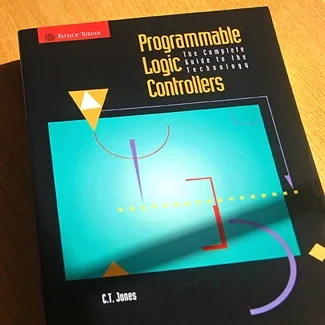
Programmable Logic Controllers
The Complete Guide To The Technology
Programmable Logic Controllers includes 15 in-depth chapters covering the basics, as well as every important aspect of PLCs. Each topic is written in a modular style that allows each subject to be covered thoroughly and in one place. Chapters on specialized topics such as Programming and Documenting the Control System, Introduction to Local Area Networks, and Intelligent I/O provide a plain English and thorough introduction to important related topics. These chapters are like books in themselves!
This book provides the most comprehensive, practical, and easy-to-understand source on the subject of PLCs. It’s a great resource for the whole engineering or maintenance team. The answers to the many questions readers have regarding system design, programming, implementation, startup, and maintenance will be made crystal clear!
Chapters
1: Introduction to Programmable Controllers
2: Number Systems, Data Formats, and Binary Codes
3: The Central Processing Unit and Power Supply
4: The PLC’s Application Memory
5: Input/Output System Overview
6: Discrete Input/Output Modules
7: Analog Input/Output Modules
8: Intelligent Input/Output Modules
9: Programming and Documentation Systems
10: Introduction to Local Area Networks
11: The Ladder Programming Language
12: Alternative Programming Languages
13: Control System Configuration & Hardware Selection
14: Programming and Documenting the Control System
15: Installation Start-up and Maintenance

Paperback: $54.99
Kindle: $29.99

Paperback: $44.99
Kindle: $29.99
Paperback: $44.99
Kindle: $29.99
Paperback: $29.99